
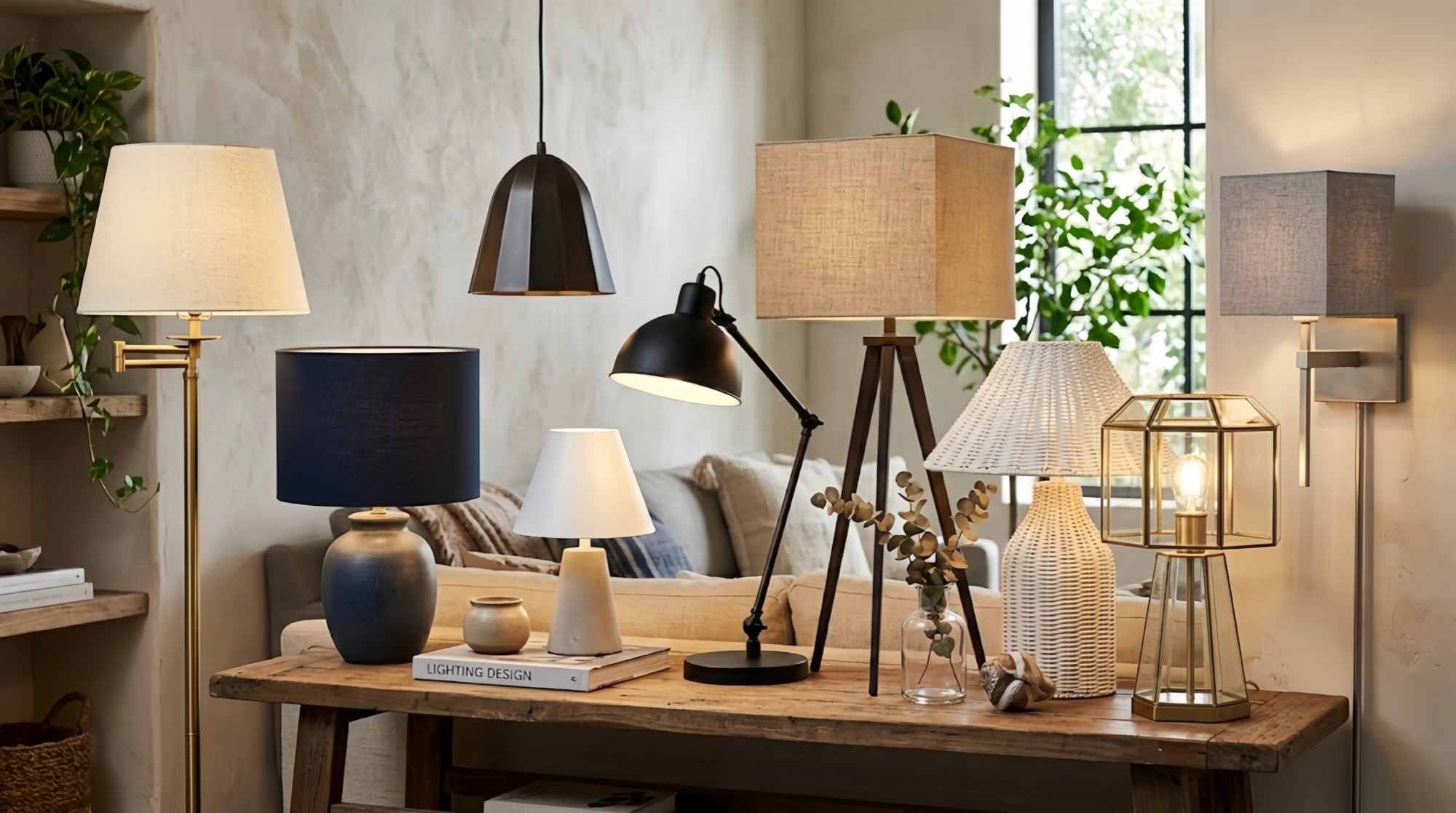
A lamp shade is easy to overlook. We often notice its color, fabric, or decorative pattern first, but the shape and structure of a shade have a much more practical job: they influence how light leaves the lamp, how much glare reaches your eyes, and how balanced the entire fixture looks.
A lamp shade is not simply a cover placed around a bulb. Its shape, frame, material, fitter, and position around the light source work together to determine how the lamp functions.
For example, a Drum shade has a relatively straight cylindrical profile, while an Empire shade is narrower at the top and wider at the bottom. These different geometries change the openings through which light can escape. The result can be a different balance of upward, downward, and surrounding illumination.
Understanding these differences is useful when replacing an old shade, identifying an unfamiliar lamp, or trying to solve a problem such as excessive glare, an exposed bulb, or a shade that looks visually unbalanced.
What Is a Lamp Shade?
A lamp shade is a decorative and functional covering placed around a light source. Its basic functions are to redirect or diffuse light, reduce direct glare, and influence the visual appearance of the lamp.
Lamp shades can be made from fabric, paper, glass, metal, woven materials, and other translucent or opaque materials. Their construction also varies. Some use a flexible material stretched over a metal frame, while others have a rigid self-supporting structure.
The shape is usually described by the shade's external profile, while the structure refers to the elements that physically maintain that profile and connect the shade to the lamp.
This distinction is important:
Shape tells you what the shade looks like. Structure tells you how it is built and supported.
Why Does Lamp Shade Shape Matter?
The shape of a shade affects three things particularly strongly: light direction, glare control, and visual proportion.
Light direction
The size and geometry of the shade's top and bottom openings influence where light can escape. A shade with a much wider bottom opening generally allows more light to leave downward, while a shade with similarly sized top and bottom openings can distribute light more evenly above and below.
This does not mean that shape alone determines brightness. Bulb output, material, lining, bulb position, and the surrounding room also matter.
Glare control
One important function of a shade is to keep the brightest part of the bulb from being directly visible from normal viewing positions. A properly positioned shade can make a lamp more comfortable to look at.
Visual proportion
The shade also acts as the upper visual mass of the lamp. Its width and height need to relate reasonably well to the lamp base. A small shade can make a substantial base appear heavy, while an excessively large shade can overwhelm a narrow base.
The Fenchel Shades similarly treats shade shape, size, material, lamp base, and intended brightness as related considerations rather than isolated decisions.
The Four Basic Lamp Shade Shapes
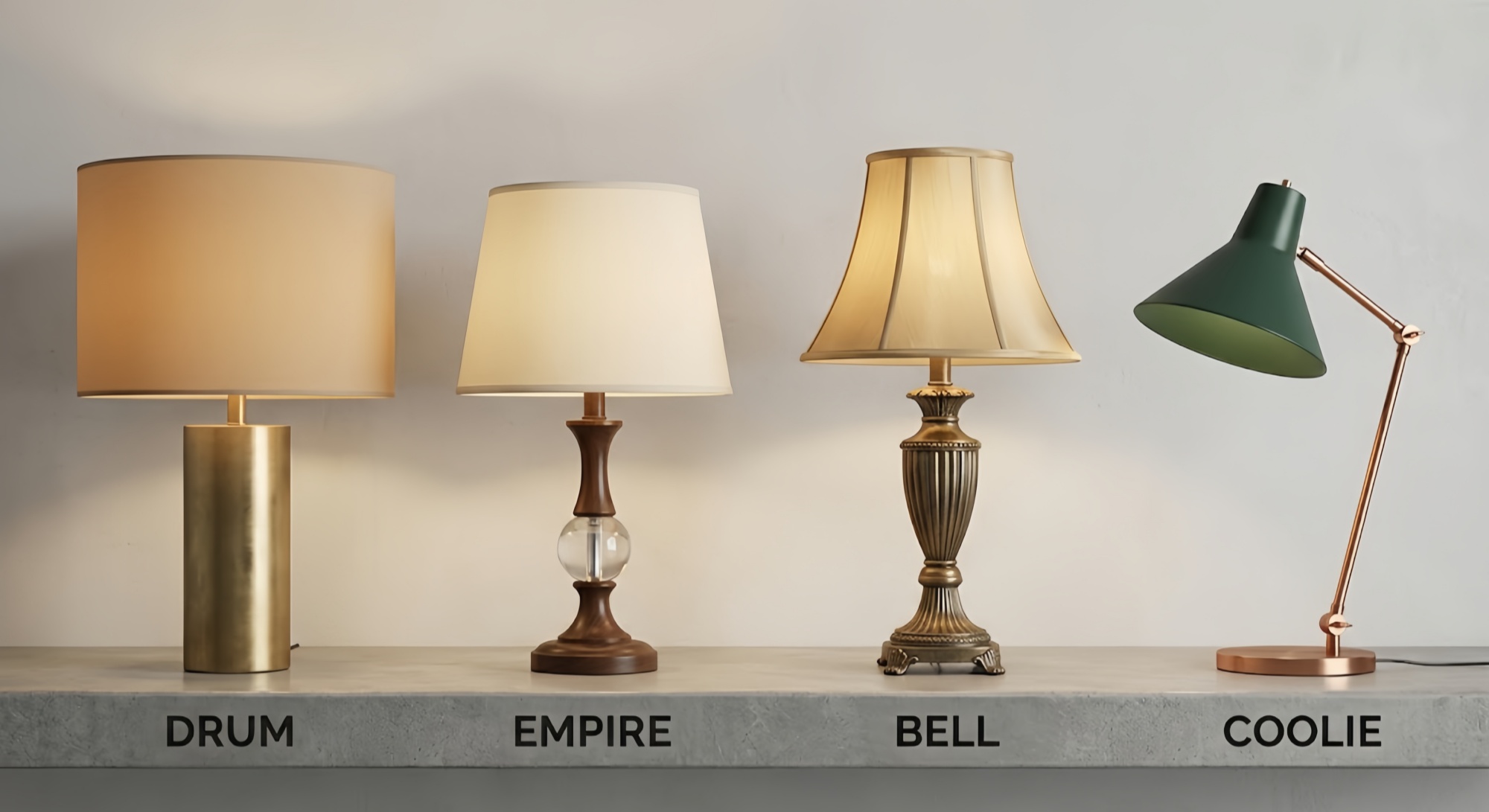
Although lamp shades come in many variations, four basic profiles are particularly useful to recognize: Drum, Empire, Bell, and Coolie.
Drum Lamp Shades
A Drum shade has relatively straight sides, with the top and bottom openings usually being close in diameter.
Its cylindrical geometry gives it a visually balanced appearance. Because the upper and lower openings can be relatively generous, a Drum shade can allow light to escape in both directions rather than strongly emphasizing only one.
This makes Drum shades common on contemporary, minimalist, transitional, table, and floor lamps.
The important characteristic is not its style label but its geometry: the top and bottom are relatively similar in size.
Specialist shade guides describe the Drum as a cylindrical form and distinguish it from tapered profiles such as Empire and Coolie shades.
Empire Lamp Shades
An Empire shade is narrower at the top and wider at the bottom, creating a straight-sided taper.
Compared with a Drum shade, the difference in opening sizes is immediately visible.
The wider lower opening tends to give the shade a stronger downward emphasis. This can be useful for lamps placed beside seating, on bedside tables, or in locations where light needs to reach a surface below the shade.
The Empire profile is one of the most traditional lamp shade forms, but its geometry can also work in less traditional interiors.
A useful way to remember it is:
Drum = relatively parallel sides
Empire = straight-sided taper
Bell Lamp Shades
A Bell shade is also narrower toward the top and wider toward the bottom, but its sides are curved rather than straight.
That curve is what separates a Bell from a conventional Empire.
The curved profile creates a softer visual transition between the upper and lower openings. Bell shades are therefore frequently associated with traditional, vintage, or more decorative lamp bases.
The shape can also influence the light distribution. Because the bottom opening is generally larger, more light can escape downward and outward.
LampsUSA describes the Bell as essentially a curved variation of the Empire profile, while specialist shade references similarly distinguish the curved sides of a Bell from the straighter sides of an Empire.
Coolie Lamp Shades
The Coolie shade takes the taper of an Empire much further.
Its top opening is relatively small, while the bottom opening is dramatically wider, producing a shallow cone-like profile.
This geometry strongly emphasizes the lower opening, so Coolie shades can direct a substantial amount of light downward and outward.
Because the shape is visually distinctive, it can also have a strong effect on the character of the lamp itself.
LampsUSA notes that the Coolie profile approaches a very wide, flattened cone and tends to emphasize light from the lower opening.
Shape vs. Structure: What's the Difference?
This distinction is central to understanding lamp shades.
Shape is the external silhouette.
Structure is the framework or construction that creates and maintains that silhouette.
A traditional fabric Drum shade, for example, may appear simple from the outside. Internally, however, it can contain a top ring, bottom ring, vertical supports, and a fitter.
The covering is then attached to this structure.
LampsUSA explains that a typical shade consists of a frame that acts as scaffolding for the shade's shape, with a covering surrounding the frame.
This is why two shades can have almost identical external profiles while behaving differently in practice. One may be fabric over wire, while another may use a rigid backing or a different internal construction.
Understanding Lamp Shade Frames
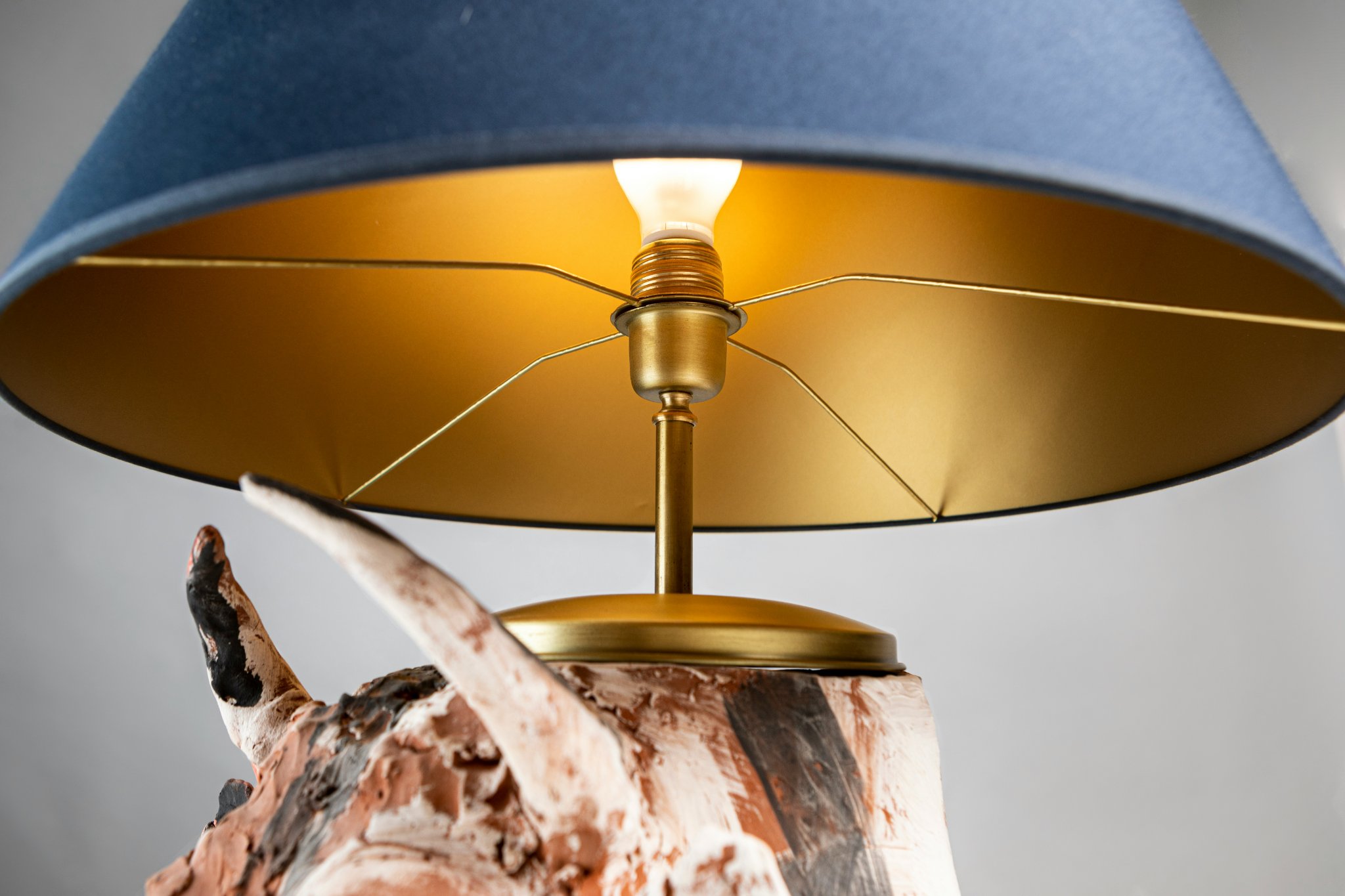
A traditional shade frame usually contains several structural elements.
Top ring
The top ring establishes the upper opening and provides part of the support for the shade's fitter.
Bottom ring
The bottom ring defines the lower opening. Its diameter has a direct relationship with the shade's overall profile.
Ribs or vertical supports
These connect the upper and lower portions of the frame and help maintain the intended shape.
Fitter
The fitter is the part that connects the shade to the lamp.
The frame therefore does more than keep the fabric in place. It determines the physical geometry of the shade and provides a stable connection point to the lamp.
A shade with curved sides requires a frame capable of maintaining that curve. A straight-sided Drum requires a different geometry.
Understanding Lamp Shade Fitters
The fitter is one of the most easily overlooked parts of a lamp shade.
You can find a shade with the correct diameter, height, and style and still discover that it cannot be installed on your lamp because the fitter does not match the lamp's mounting system.
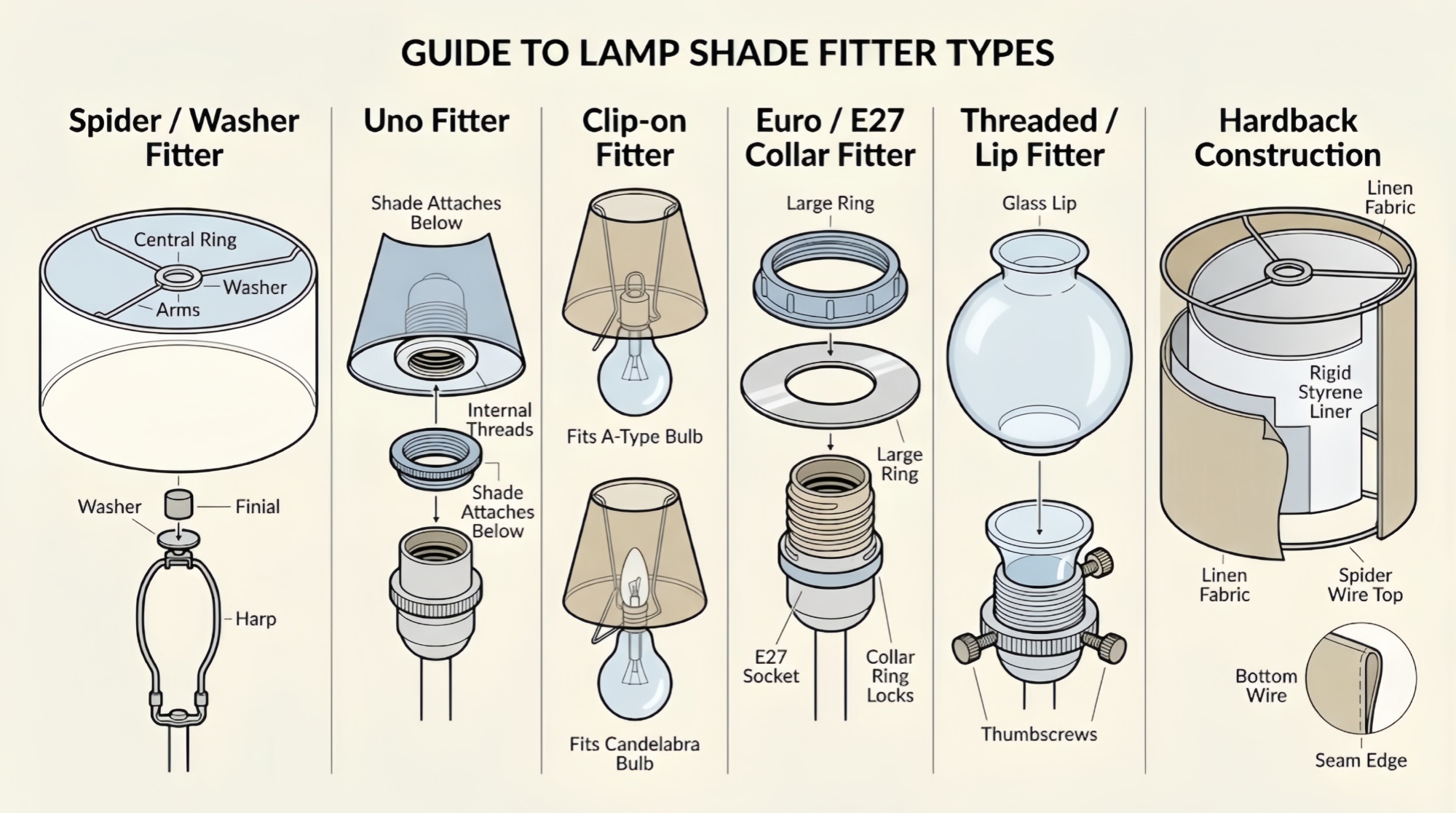
Three common types are Spider, UNO, and Clip-On.
Spider Fitter
A Spider fitter normally sits on a lamp harp.
The basic arrangement is:
lamp base → harp → spider fitter → finial
The fitter has several metal arms extending toward a central ring. The finial secures the shade from above.
This is a common arrangement for traditional table and floor lamps.
The Spruce identifies Spider as the common fitter used with harps and explains that the shade is secured with a finial.
UNO Fitter
An UNO fitter connects directly to the lamp socket rather than sitting on a traditional harp.
Different UNO systems exist, so the exact socket and threading arrangement matters.
This is why “UNO fitter” alone does not always tell you whether a shade will fit a particular lamp.
Before replacing a shade, check the actual socket and mounting system rather than assuming that all UNO fittings are interchangeable.
Clip-On Fitter
A Clip-On fitter attaches directly to the bulb using a spring-like clip.
These fittings are commonly used with smaller shades, including certain decorative lamps, sconces, and chandelier-style fixtures.
Because the fitter attaches directly to the bulb, the shade needs to be appropriately sized and designed for that application.
The Spruce's fitter guide distinguishes Spider, UNO, Euro, and Clip-On systems and emphasizes that the fitter needs to match the lamp's construction.
How Lamp Shade Shape Affects Light Distribution
One of the most useful things to understand about lamp shades is that shape does not work independently from material.
Think of the lighting effect as the interaction between:
shade geometry + shade material + bulb position + bulb output
A Drum shade may have relatively large upper and lower openings, but if its material is highly opaque, relatively little light may pass through the sides.
A translucent fabric shade behaves differently because some light passes through the shade itself.
LampsUSA explains that shade coverings can diffuse and reflect light, while the color and lining can also influence the light that passes through the material.
Other lighting guides make the same broader distinction: translucent materials tend to provide more diffusion, while opaque materials can create more directional illumination.
This is why it is misleading to say that one shade shape is always “brighter” than another.
A better statement is:
Shade geometry influences where light can escape, while material influences how much light passes through the shade itself.
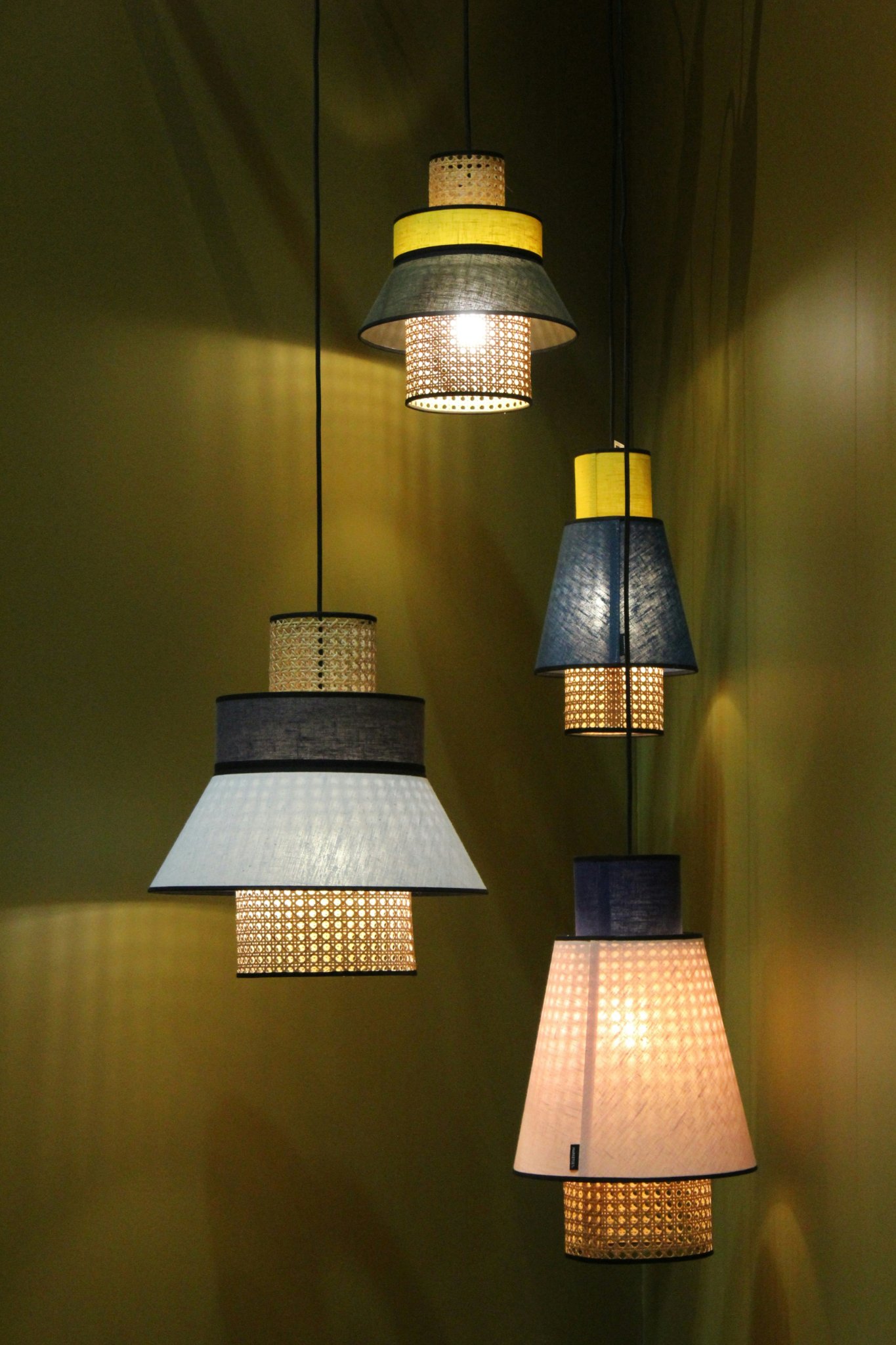
Shape, Material, and Proportion Work Together
When evaluating a lamp shade, it helps to consider three separate questions.
Does the shape suit the lamp?
A cylindrical base may visually relate well to a Drum shade. A sculptural or curved base may work naturally with a Bell shade.
But matching is not mandatory. Intentional contrast can also create a successful design.
Does the material provide the right amount of diffusion?
Fabric, paper, glass, metal, and woven materials can produce very different lighting effects.
Fabric shades generally soften the appearance of a light source, while more opaque materials can control light more directionally.
LightsLux makes the same practical distinction in its discussion of shade materials: fabric shades can soften light, while metal and glass can produce a stronger or more focused lighting effect.
Does the proportion feel balanced?
Traditional sizing rules can be useful starting points, but they should not be treated as universal laws.
The shade should be evaluated together with the base, not by itself.
Look at the complete lamp from the normal viewing position.
Does the shade visually overwhelm the base?
Does the base make the shade appear too small?
Is the bulb hidden appropriately?
Does the lamp feel stable?
These questions are often more useful than following a single measurement formula.
How to Diagnose a Lamp Shade That Looks Wrong
If an existing lamp does not look or function correctly, replacing the shade immediately may not be necessary.
Start with the problem.
The shade looks too high
If the lamp uses a Spider fitter, check the harp height.
The shade may be perfectly suitable but positioned too far above the lamp base.
The bulb is visible
Check the shade's height and the position of the fitter.
Also consider where you normally sit or stand. A shade can conceal a bulb from one angle while exposing it from another.
The lamp base looks too heavy
The shade may be visually too narrow or too small for the base.
Try judging the entire silhouette rather than focusing on the shade alone.
The lamp feels too dark
Do not assume the shape is the problem.
Check:
bulb output;
shade material;
shade lining;
top and bottom openings;
distance between bulb and shade;
whether the surrounding room surfaces absorb or reflect light.
A fabric shade can soften light considerably. LightsLux also notes that fabric shades can diffuse light and reduce harsh brightness in practical room settings.
A Simple At-Home Test for Lamp Shade Problems
You can learn a surprising amount about a shade without replacing anything.
First, switch on the lamp and view it from the position where you normally use it.
Then ask:
Can I see the bulb directly?
If yes, glare may be an issue.
Is the surface below the lamp adequately illuminated?
If not, the shade may not be directing enough light downward.
Is the surrounding wall receiving some useful illumination?
If yes, the lamp may be contributing to ambient light as well as local illumination.
Does the shade look balanced with the base?
If not, the issue may be proportion rather than the shade's style.
This practical test is often more useful than judging a lamp from a product photograph because the real lighting effect depends on the bulb, viewing angle, surrounding surfaces, and room.
Final Takeaway
A lamp shade is more than a decorative cover around a bulb.
Its shape controls geometry, its frame maintains the structure, its material affects light transmission, and its fitter determines how it connects to the lamp.
The most useful way to understand lamp shades is therefore to look at the entire system rather than one feature in isolation.
A Drum shade, Empire shade, Bell shade, and Coolie shade can all look very different because their profiles change the relationship between the upper and lower openings. That geometry influences light distribution, while the material determines how much light passes through the shade itself.
If a lamp does not look right or produce comfortable light, start by identifying the actual problem. Check the shape, proportions, fitter, bulb position, and material before assuming that you simply need a different style.
Once you understand those relationships, lamp shade selection becomes much less about guessing and much more about understanding how the lamp actually works.
FAQs
What is the most common lamp shade shape?
Drum, Empire, Bell, and Coolie are among the main traditional lamp shade profiles, although square, rectangular, oval, hexagonal, and other geometric forms are also widely used.
Does lamp shade shape affect brightness?
Yes, but not by itself. Shape affects the direction and openings through which light can escape. Material, opacity, lining, bulb output, and bulb position also influence the final lighting effect.
What is the difference between Drum and Empire lamp shades?
A Drum shade has relatively similar top and bottom diameters and relatively straight sides. An Empire shade is narrower at the top and wider at the bottom, creating a more obvious taper.
What is the difference between Empire and Bell lamp shades?
Both are narrower at the top and wider at the bottom. The main structural difference is that Empire shades generally have straighter sides, while Bell shades use curved sides.
What is a Spider fitter?
A Spider fitter is a metal support structure with a central mounting ring. It normally sits on a lamp harp and is secured from above with a finial.
Share:
Best Ceiling Fan with Light Styles for Modern Homes: How to Choose the Right Design for Your Space
20 Kitchen Island Lighting Ideas for a Modern Kitchen: Stylish & Practical Designs